Cultivating advocacy with the Momentum Framework
On 21 May 2025, the Melbourne Business Agility Meetup welcomed Sean Flaherty of Advanced Leadership Concepts, who ran an abridged version of his renowned leadership transformation framework workshop. Sean was visiting Australia to deliver workshops at the Leading the Product conference in Melbourne and Sydney, and to engage with company owners and senior leadership teams through Vistage International.
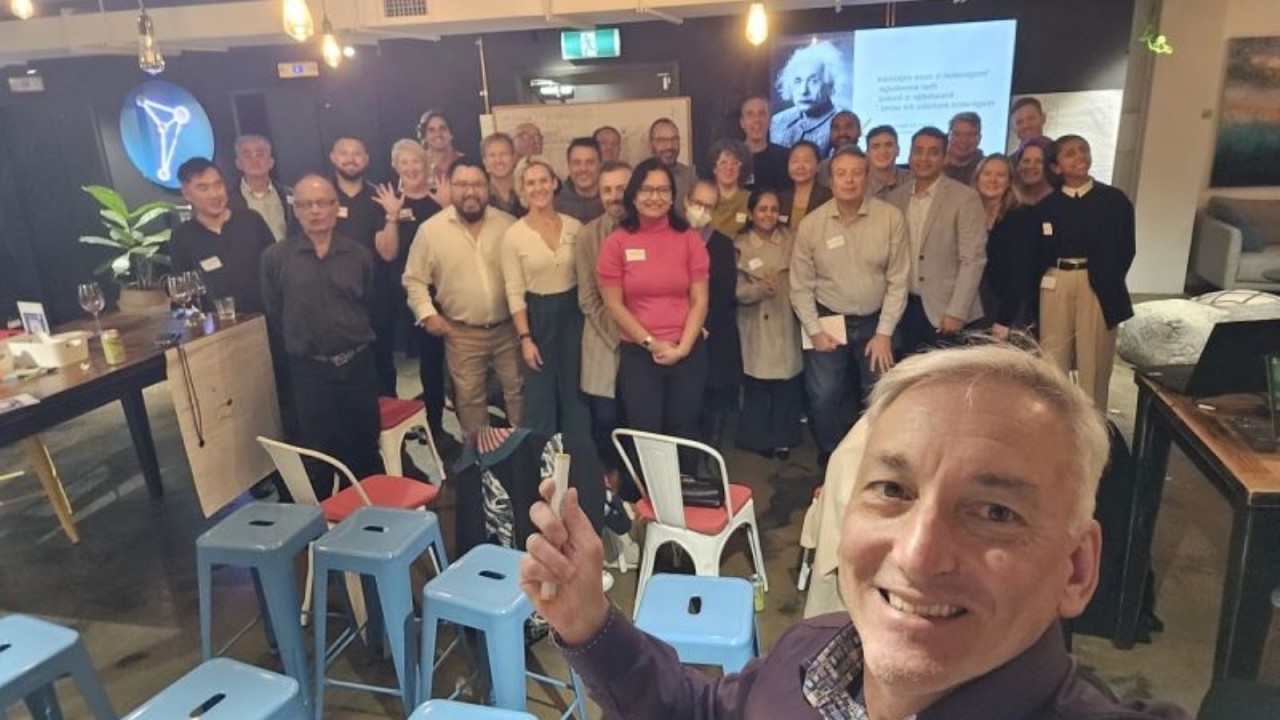
Why Sean? Why advocacy?
Sean began by sharing career insights, from the US Navy to leading ITX, a 300+ person custom software development consultancy. Drawing on 25+ years of experience, he explored what differentiates successful leadership and teams — synthesised into his Momentum Framework. The framework emphasises human factors driving genuine employee and customer advocacy, aligning with the Business Agility Institute’s research on leaders’ role in innovation, delivery, and generative culture.
Advocacy matters not only in business but for community clubs, groups of friends, non-profits, and any collective. Strong, sustainable relationships built through advocacy create vibrant, purposeful communities.
Sean’s work centres on systems and human behaviour: leadership challenges typically stem from systemic issues rather than individual performance alone.
Leadership is about creating possibility.
Sean differentiates leadership from management: management focuses on predictability and consistent execution; leadership inspires, unlocks potential, and nurtures innovation.
Foundational science — and graphs
Sean connects observations on human behaviour with scientific research, transforming ideas into validated insights. His narrative is accompanied by hand-drawn graphs and charts — it pays to be well stocked with large sheets of paper when he is in the room.
People, strategy, and tactics
Sean’s core assertion: the vast majority of problems are people problems — even in highly technical businesses.
He described strategic planning as an oxymoron, highlighting a clear distinction between strategy and tactics. He referred to Sun Tzu’s Art of War, which separates strategy (long-term thinking) from tactics (short-term execution). Confusing the two often leads to dysfunction; effective leadership requires distinguishing strategic vision from tactical implementation.
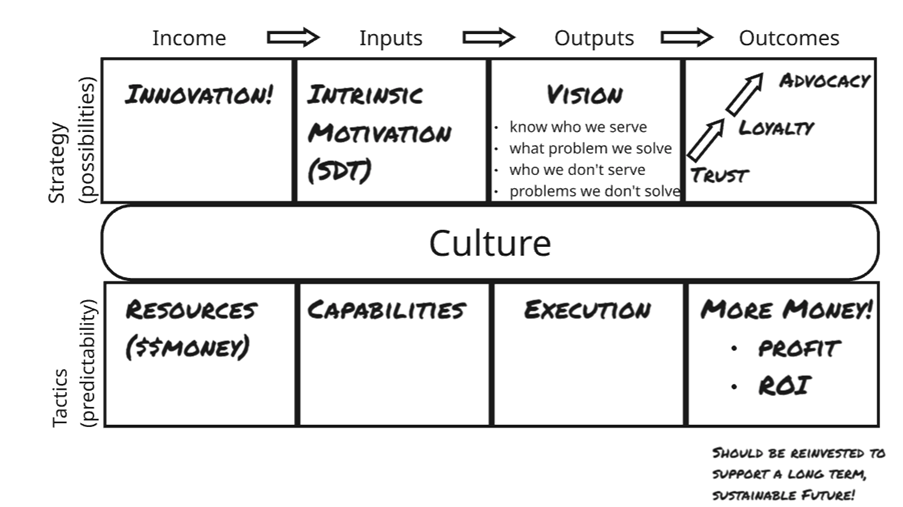
Sean illustrated this by drawing a flow from income → inputs → outputs → outcomes. Many leaders struggle to zoom out to this bigger picture. Recognising the flow is essential for aligning tactical actions with strategic goals.
Advocacy: what is the goal?
The goal: turn as many people as possible into advocates for the organisation’s mission. Revenue and profit matter — without them, organisations cease to exist — but the ultimate purpose goes beyond financial success. Increased profit provides more choices to invest in turning stakeholders into passionate advocates.
True advocacy occurs when stakeholders feel deeply connected to the organisation’s purpose and actively engage in its evolution. Advocates support, defend, and promote the mission, creating a resilient network of support and growth.
An advocate genuinely invests in your collective creative future, contributes ideas proactively, provides constructive feedback, and represents the organisation externally. They appear and evolve from trust.
The relationship ladder
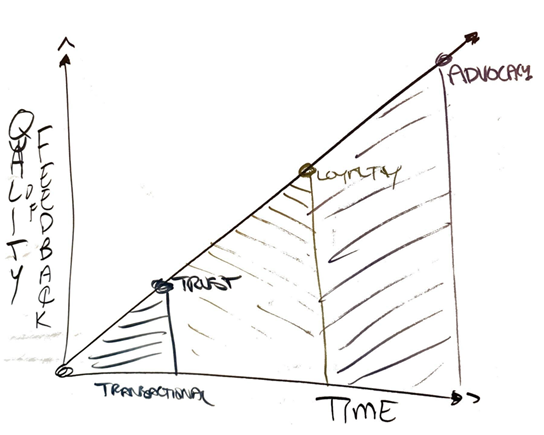
Central to Sean’s message is the Relationship Ladder — relationships evolving from trust through loyalty to advocacy:
- Trust develops through consistent, reliable experiences demonstrating genuine care and competence.
- Loyalty emerges when trust is continually reinforced.
- Advocacy — the highest tier — involves stakeholders actively investing in the organisation’s future: feedback, promotion, defence, and collaborative problem-solving.
Advocacy is vital for resilience and competitiveness; advocates enhance visibility, market reach, and innovation.
Innovation as strategic income
An idea might have value, but you won’t know until you put it into the world, and the world recognizes it as profound.
Sean frames innovation as critical strategic income, derived from advocacy relationships. Innovation involves incremental improvements that enhance trust, loyalty, and advocacy — and the ability to sense and respond in unpredictable environments. Citing Daniel Goleman’s emotional intelligence research, Sean identified open awareness — an environment supportive of creativity — as essential.
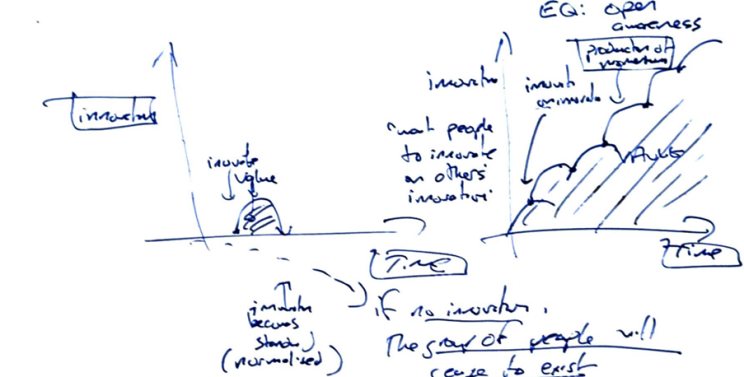
Innovations initially create significant value but become normalized, losing competitive advantage as they become expected standards. Sean emphasized innovation on innovation — building on others’ innovations to generate exponentially growing value, which he termed the production of momentum.
Emotional quotient (EQ) fosters open awareness, essential for recognizing opportunities to innovate further. When EQ is lacking, innovation stalls. Without innovation, purpose diminishes, leading to disengagement and dissolution of collective effort.
Innovation can’t be forced; leaders must create environments supportive of innovative thinking and continuous improvement before ideas become normalized.
The power of advocates
Advocates recommend, challenge, and elevate organisations through constructive feedback. They continuously engage, defend and promote externally, and offer feedback that fuels growth.
Constructive feedback and leadership’s role
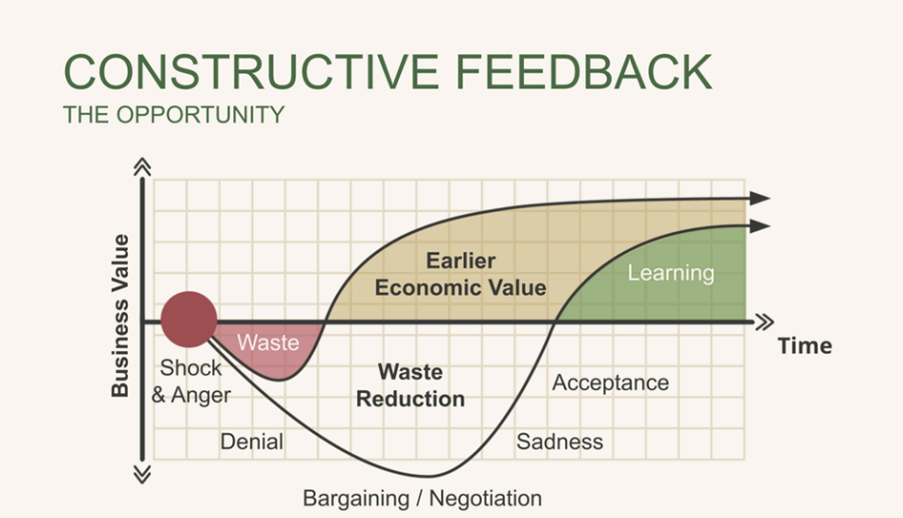
Sean discussed the economic significance of constructive feedback and leaders’ roles in managing its reception. Using Elizabeth Kübler-Ross’s grief curve, he illustrated typical emotional responses to feedback — and the importance of progressing toward acceptance to extract value.
Sean’s recommended feedback process:
- Recognize feedback as a sign of stakeholder investment.
- Publicly celebrate feedback; reframe it as growth. “Feedback is a gift, coming from a good place.”
- Maintain a learning-focused mindset. Ask: What is our customer trying to teach us?
- Filter, aggregate, and act on feedback — a core leadership activity.
- Teach the cycle; foster ongoing awareness of feedback’s value.
Nurturing feedback well leads to better feedback over time. Ignoring it loses economic value.
Core leadership capacities
Sean identified two essential capacities:
- Influence — mobilizing stakeholders toward strategic goals.
- Caring — authentically demonstrating concern for stakeholders’ welfare.
Great leadership creates environments conducive to creativity.
Culture and strategy
Sean contested “culture eats strategy for breakfast,” proposing that culture and strategy mutually reinforce each other — culture as the unique context enabling strategic execution.
Implementing the Momentum Framework
Sean urged participants to model desired leadership behaviors and address challenges using the framework. He cited Grace Murray Hopper: “The most dangerous phrase in business is: ‘This is how we’ve always done it.’” Emphasize continuous innovation — small, cumulative improvements — facilitated by open awareness and an evolving environment.
Discussion: questions and answers
What if you’re not the leader? Sean reiterated the leadership–management distinction: everyone can lead through influencing and inspiring. Communicate benefits proactively to management; take responsibility for personal conduct and growth. Most people have relatively little control but huge influence — if they choose to use it in an empowered environment.
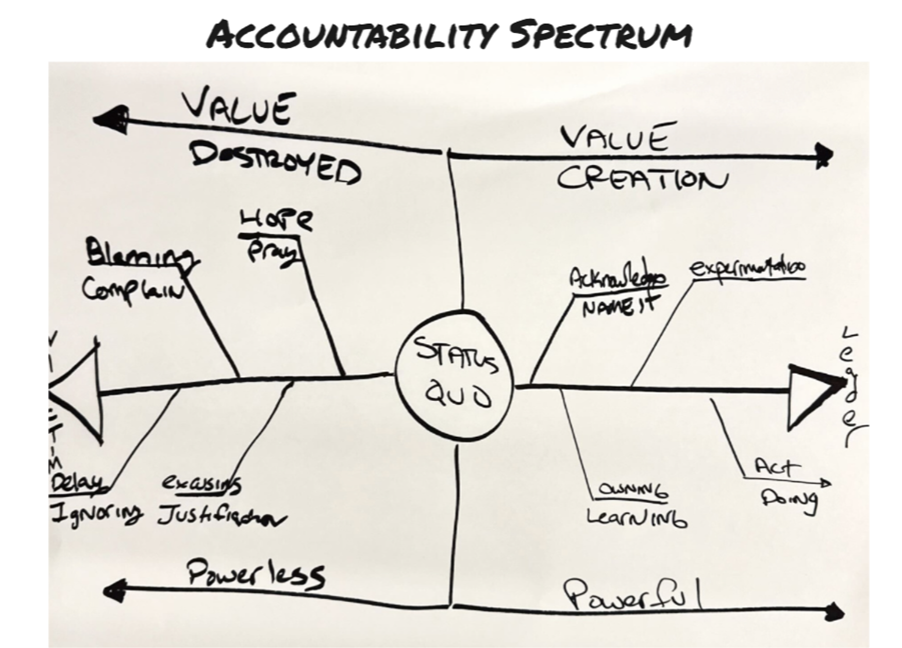
What if you feel completely unempowered? Sean suggests changing your circumstances as soon as possible. It’s the crux of leadership, and it’s hard.
Where to start? Model great leadership. Prioritize continuous self-improvement. Use tools and scientific evidence to advocate for change.
Sean’s workshop highlighted the depth of his full Momentum Framework sessions. He can be reached at Advanced Leadership Concepts.
How this summary was created
This summary was created by transcribing audio recorded at the meetup. An LLM (OpenAI ChatGPT 4.5) generated a first pass; I compared it to my notes and expanded areas where Sean spent considerable time or that I found insightful. This first editable draft took about an hour — significantly faster than without transcript extraction and summarization. I then edited for flow and inserted quotes. I take full accountability for the end product and welcome your feedback.
Thanks
- Sean and the team at Advanced Leadership Concepts
- TeamForm for sponsoring the location and refreshments. Without sponsors these events don’t happen!