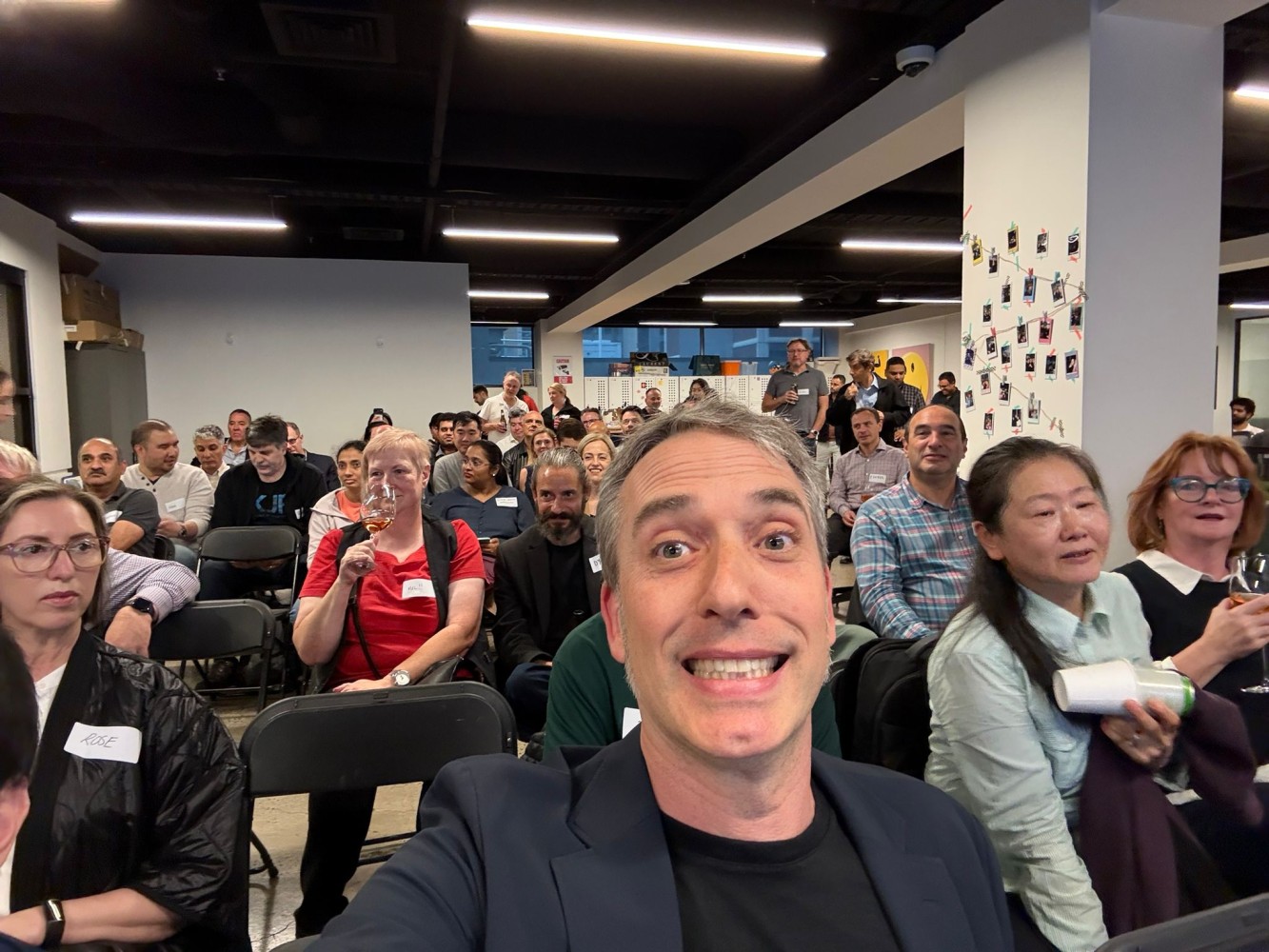
Delivery acceleration with AI-powered people and process
At the March 2026 Agile Project Managers Meetup in Melbourne, Andrew Mair, Neha Rahaman, and Peter Lam led a wide-ranging session on what AI actually means for project delivery: not the vendor pitch, but the practitioner reality. The core question threading through the evening: does AI just speed things up, or does it change how we run projects more fundamentally?
The answer, as it turned out, was firmly the latter.
The uncomfortable starting point
Peter opened with a framing borrowed from PMI that projects are meant to create value, with “project benefits” defined as the value created for the sponsor or beneficiary, and benefits realization as the means of ensuring that value is derived from project outputs. Yet the track record is sobering: PMI reports that fewer than two-thirds of projects meet their goals and business intent, and about 17% fail outright.
If project delivery was already struggling to land value before AI, bolting AI onto broken processes won’t fix the problem. It might accelerate the wrong things.
That set the tone. Project managers have the opportunity to be at the centre of this shift, not observing it from a governance silo.
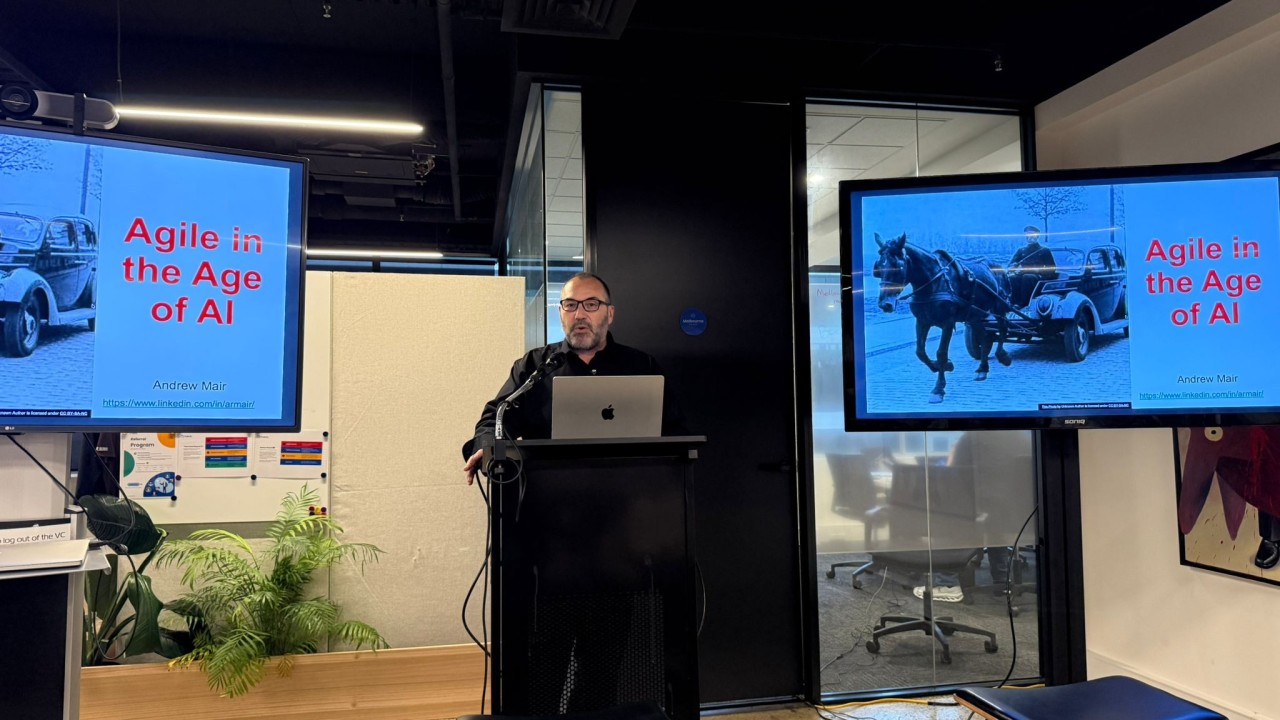
The event welcomed Andrew to the lectern. His background in getting AI working in the higher education sector — one with plenty of ambition but very constrained budget — gave the framing a practical edge. The Chisholm TAFE AI Centre of Excellence, announced in late February 2026, is one signal that institutional investment is beginning to follow the hype.
What AI is actually changing in projects
The session walked through several ways AI is reshaping the project landscape and was careful to separate signal from noise.
Task replacement, not job replacement. AI is absorbing parts of what people do: drafting, summarising, analysing, generating code, but it isn’t eliminating roles wholesale. The more interesting effect is on the shape of roles. Graduates and junior hires feel the shift most acutely: AI can now do much of what entry-level workers were hired to learn by doing, which raises real questions about how the next generation builds competence.
Agentic AI changes the architecture. The conversation has moved beyond chatbots and copilots. Agentic AI, where AI systems take action and don’t just advise, demands new technical architectures, new oversight models, and a different relationship between project teams and the platforms they build on. Less focus on rigid upfront architecture diagrams, more emphasis on adaptive, platform-oriented designs that can accommodate agents as first-class participants.
Shadow AI is already here. People are using AI tools whether or not the organisation has sanctioned them. “AI slop” creating reams of low quality, unreviewed output is a growing risk. The governance challenge has moved from “should we allow AI?” to “how do we make unsanctioned use visible and safe?”
Andrew referenced Anthropic’s research on labour-market impacts as a grounding point: the displacement effects are real, and they’re concentrated in knowledge work.
The shift from control to enablement
One of the sharpest reframes of the evening was the shift in the project manager’s posture of enabling and governance from control and restrict.
The old model of gating every decision, locking down every tool, and writing every requirement before starting doesn’t survive contact with AI-enabled teams. Low-code and “disposable software” blur the line between business users and developers. Requirements can emerge iteratively rather than being exhaustively gathered upfront. The PM’s job becomes less about controlling inputs and more about setting guardrails that allow teams to move fast without creating chaos.
This is a governance problem, not a tools problem. And it’s one that project managers are well-positioned to solve if they’re willing to let go of the clipboard.
Market-wide, we are seeing an increasing number of orchestrating roles shift from taking a gate-driven “no unless I say yes”, to providing the framework, guardrails, and continuous-but-asynchronous support that enables teams to move with the presumption of “yes unless I say no”. Recent research has shown that companies that adopt this well see more than a 10% increase in revenue per employee.
Agile in the age of AI: more relevant, not less
A natural question surfaced: does AI make agile obsolete? Andrew’s argument was the opposite. The core ideas of agility — short feedback loops, working in small increments, prioritising learning — become more important when the pace of change accelerates.
But the practice of agile needs to adapt. A few shifts stood out:
AI as a team member. Not metaphorically — practically. AI agents can participate in workflows, handle routine tasks, and surface information. The team construct changes when one of your “members” doesn’t need sleep, doesn’t attend standups, and can process a backlog overnight.
Fewer specialists, more hybrid roles. When AI handles much of the routine work in a discipline, the value shifts to people who can work across boundaries. The “T-shaped” professional may give way to an “M-shaped” one — multiple areas of depth, connected by breadth.
Sense-making as the high-value activity. AI is strong at generation; humans are still better at planning, prioritising, and making judgement calls in ambiguous situations. The opportunity is to redirect human effort toward sense-making — estimation, prioritisation, workflow design — and let AI handle the throughput.
Andrew offered a vivid analogy: AI can feel “like having an offshore team at your disposal.” But the same rules apply: it only works well with good guardrails, good standards, and good practices underneath. Without those foundations, you get rework and confusion at higher speed.
Shorter, verifiable decision and delivery cycles
That was the phrase Andrew circled back to repeatedly. Not just shorter sprints, but genuinely compressed cycles where decisions are made, tested, and validated faster. The previous rationale for timeboxing was to prevent runaway scope; the new rationale is to match the pace at which AI-enabled teams can actually produce and learn.
The people question
The session’s most animated discussion was around what AI means for roles, expertise, and careers.
Do you still need a full-time Scrum Master? Maybe not, or maybe the role evolves into something broader. Is your developer now an architect? Quite possibly, if AI is writing most of the code and the human’s job is design, review, and integration.
The Project Manager becomes an orchestrator, coordinating AI and human contributions, managing quality, and ensuring the team doesn’t lose sight of why something is being built.
Andrew drew a contrast between the mastery model (deep expertise built over 10,000 hours) and the matrix model (experts on tap, shared across teams). AI may help bridge expertise gaps, for example a junior person with good AI tools can produce work that looks senior, but that doesn’t remove the need for genuine mastery. Someone still has to know when the AI is wrong.
A pointed question from the floor: how does industry develop mid-career skills if AI absorbs the work that juniors used to learn on? No easy answer emerged, but the room agreed it’s one of the most consequential questions of the next few years.
The measurement trap — panel discussion
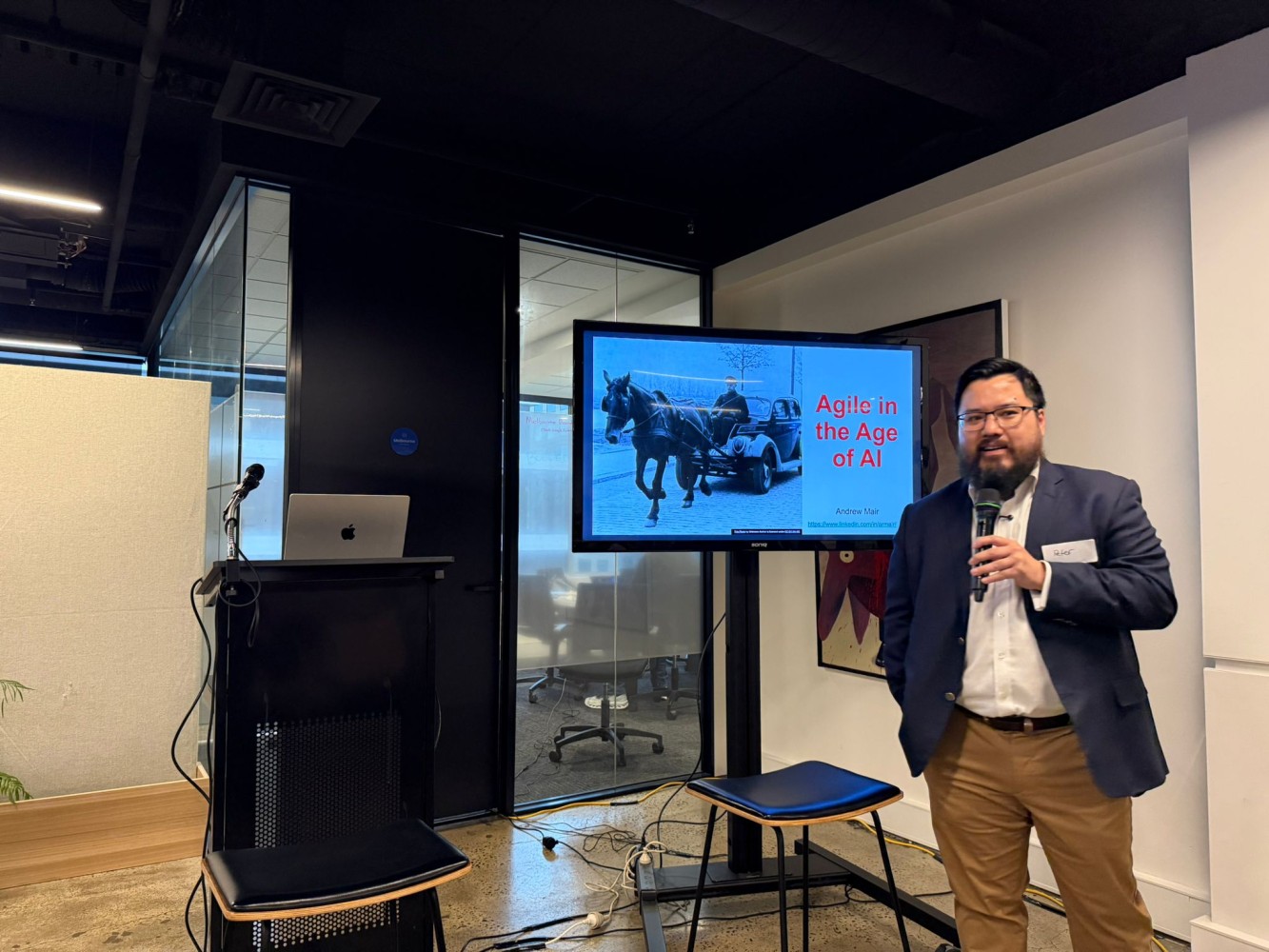
The panel discussion, featuring Neha Rahaman, Andrew, and Peter Lam pushed into how organisations should measure AI’s impact.
Individual productivity gains are already visible. Analysis time can drop by 50–60%. Code generation time can halve. However, there were two clear challenges that this could create:
-
The ability to use the technology to realise benefits relied on mature, rigorous technical and delivery approaches. Without the rigor – the benefits were limited to individual productivity and unlikely to be realised at the team or portfolio layer
-
Speeding up one step often just moves the bottleneck. If your developers produce code twice as fast but review and deployment queues stay the same length, your lead time barely changes.
The view was to be more holistic when looking for opportunities to leverage AI. The recommendation was to benchmark the whole flow, not just the task. Where are the handoffs? Where are the constraints? What’s the actual lead time from idea to outcome? This echoes a familiar theme from lean and flow-based thinking — and it matters even more when AI compresses the “doing” while leaving the “waiting” untouched.
By 2026, the panel suggested, organisations should be able to measure AI benefits at the project level, not just the individual level. But getting there requires deliberate measurement and honest accounting of where time actually goes.
Don’t outsource your thinking
The sharpest caution of the evening came from Neha’s wording around cognitive offloading. AI makes it easy to generate plausible-sounding outputs without deeply understanding the problem. The risk is that teams stop thinking strategically — they produce faster but understand less.
Andrew’s framing: understand why something was built, not just how quickly it was produced. Neha reinforced the point — if you’re using AI effectively right now, you’re already ahead, but only if you’re maintaining the discipline to question what it produces.
The room’s consensus: don’t let go of strategic thinking. AI should amplify judgement, not replace it.
Where this leaves project managers
The evening’s arc moved from individual impact (faster tasks) to project impact (compressed cycles, changed roles) to portfolio impact (throughput gains that create new coordination challenges). At each level, the message was consistent: AI amplifies what’s already there. Good practices get better. Poor practices get faster at failing.
For project managers, the call to action is clear. Lean into enablement and governance. Rethink team structures and role boundaries. Measure flow, not just output. Invest in the human skills of sense-making, judgement, strategic thinking that AI can’t yet replicate. And resist the temptation to treat AI as a shortcut that removes the need for disciplined delivery.
The tools are new. The fundamentals aren’t.
Acknowledgements
Thanks to Claritas Consulting for organising, Peter Lam for reviewing this article, and Fabric Group for sponsoring the event. All much appreciated.