Tomorrow-Ready DNA: the updated Domains of Business Agility
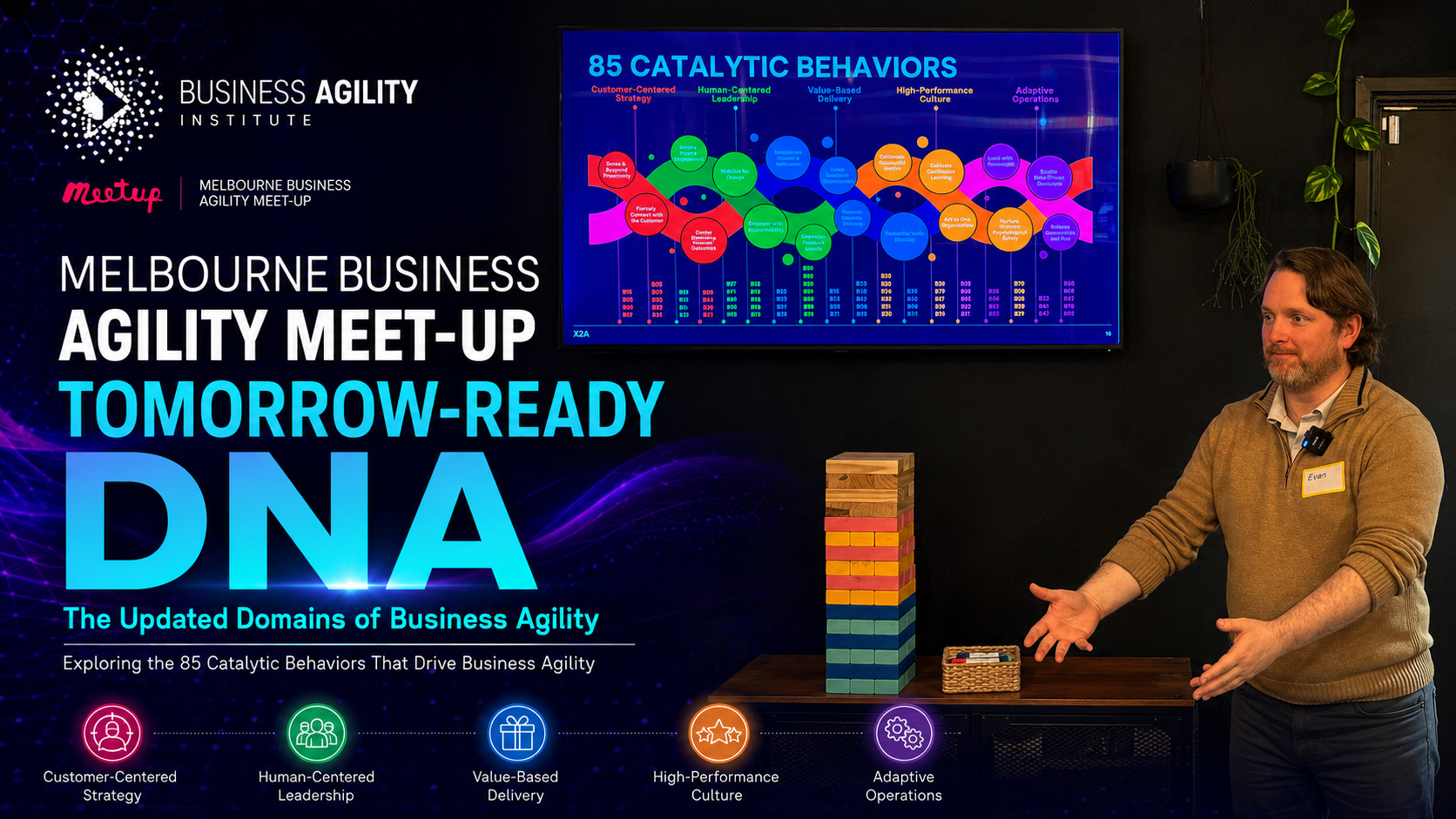
At the June 2026 Melbourne Business Agility Meetup we welcomed Evan Leybourn, co-founder of the Business Agility Institute and now Chief Product Officer of X2A who walked us through the first major refresh of the Domains of Business Agility in five years.
The updated domains are now live on the Business Agility Institute site, published under Creative Commons.
The key thought of the night: How can organizations effectively keep up with a changing world? So they are ready for tomorrow, not proofed against it. The Domains were reframed, not reinvented, and the refresh says that in language executives actually use, without leaning on the word “agile.”
Takeaways
- The model decoupled itself from “agile” on purpose. Tomorrow-Ready DNA is about readiness for whatever tomorrow brings, expressed in capabilities and behaviours, not framework labels.
- The structure is stable; the capabilities sharpened. You still have five domains, 18 capabilities, and 85 behaviours, but Mobilize for Change is new, Orchestrate Human-AI Workflows is the big evolution, and several renames track how leaders actually talk.
- It is still a behavioural model. Capabilities come from what people do, not from posters or training decks, and durable change means designing the environment (nudges, incentives, governance) so the new behaviour is the easy path.
- BAI now has a path to action. X2A and the four playbooks are the answer to “we see the gap in our profile: what do we do on Monday?” without turning the Institute into a consultancy.
If you already use the Domains in assessments or change work, the refresh is worth a re-read: the behaviours are largely comparable, but the capability language is where executives and AI-era workflows show up.
Two linked changes are happening: a rebrand and re-think of the model itself (now called Tomorrow-Ready DNA), and an organisational shift with the merger of the Business Agility Institute and ICAgile into a new entity, X2A.
From “future-proof” to “tomorrow-ready”
Evan opened with a key distinction:
Being future-proof is like being waterproof: you keep the future out so you can keep doing what you have always done. There is value in that. But the reality is that what you offer tomorrow will not be what you offer today. Organisations need to be ready for the future, not protected from it.
That framing carries BAI’s longstanding definition: business agility is the behaviours and capabilities that afford an organisation the freedom, flexibility, and resilience to achieve its purpose, no matter what tomorrow brings. The DNA metaphor and the Tomorrow-Ready DNA name are packaging for executives; the research question underneath is the one BAI has pursued since the Domains first shipped in 2017.
The drivers won’t surprise anyone: customers have more options and more split attention; AI is reshaping how work gets done (you can’t use AI effectively if you can’t be agile); the workforce keeps changing what it expects from employers; and the geopolitical and economic backdrop keeps producing disruptions nobody predicted. Evan’s point was that disruption isn’t always bad, but it is always different, and rarely predictable.
The BAI + ICAgile merger, and X2A
In February 2026, BAI announced it had merged with ICAgile, the global education and certification provider. The combined commercial entity is X2A.
The split of responsibilities is deliberate:
- The Business Agility Institute (BAI) continues as the research and assessment body: the data, the profiles, the behavioural studies across some 2,500 organisations. Practitioner communities like this meetup will continue to align with the BAI.
- X2A is the commercialisation engine, built around the idea of the “human advantage”, and the vehicle for turning BAI’s research into something organisations can actually act on.
Evan framed BAI’s historical limitation: as a research organisation, its job was “to shine a light on the path ahead of you, but not to walk the path with you.” The problem is that plenty of organisations don’t want a light, they want to know the next step. X2A is the answer to that.
Evan noted upcoming ICAgile announcements coming on the week of 8th June, with full details in July.
Tomorrow-Ready DNA: same structure, new metaphor
The previous model (version 4, published October 2020) used a periodic table metaphor. The new model swaps that for DNA, the building blocks of a living system.
The framing is intentional: an organisation is a living system, and healthy behaviours signal long-term resilience and performance. Evan was blunt that the word “agile” does not appear anywhere in the model, and has not since version 2. The point is decoupling the building blocks from any single method: you might get there through agile, through something else, or through whatever comes next.
The structure is unchanged and still nests three levels:
- 5 Core Domains: the desired outcomes of greater agility.
- 18 Essential Capabilities: what lets an organisation get things done.
- 85 Catalytic Behaviors: clear, observable, repeatable actions (up from 84, because of one brand-new capability).
It remains, fundamentally, a behavioural model. Evan’s line on that: if you want new ways of working, somebody has to do something differently. Capabilities are built through that behaviour change, not through posters or programmes alone. Because BAI runs longitudinal research across 2,500 organisations, the 85 catalytic behaviours have deliberately not changed much; data from the 2020 model stays comparable with today’s.
The four key principles also carry over:
- Spectrum, not a switch: agility is a matter of maturity, not have/have-not.
- Strengths vary: no organisation is uniformly good or bad across all areas.
- No single path: it’s the capability that matters, not the framework or method.
- Change behaviours: if you act with agility, you have agility.
The five domains and what changed
The domains themselves only shifted in language, but the capabilities underneath saw the real work. Below is the detail behind takeaway 2, domain by domain, with the notable changes called out.
1. Customer-Centered Strategy
(previously: Responsive Customer-Centricity)
- Fiercely connect with the customer: was “fiercely champion the customer”. “Champion” felt too one-directional and cheerleader-ish; “connect” implies an equal exchange of meaning: you have to understand customers before you can advocate for them.
- Sense & respond proactively: unchanged.
- Center strategy on customer outcomes: evolved from “adapt strategy seamlessly”, and moved here from the operations domain. The motivation: adaptive strategy in isolation is meaningless. What are you adapting to? Your customers’ changing needs.
2. Human-Centered Leadership
(previously: People-first Leadership, “people” became “human” to align with X2A’s “human advantage” language)
- Empower with accountability: unchanged. Empowerment without accountability is laissez-faire; accountability without empowerment is command-and-control. You need both, in balance, and ideally both high.
- Engage diverse perspectives: was “integrate diverse ideas”. The shift is from cheap ideas to lived perspectives: what someone has seen and experienced.
- Champion people’s growth: was “realise people’s potential”, which was a bit fluffy. The new wording is more direct about what leaders are actually trying to do.
- Mobilize for change: brand new. This is the headline addition. When leaders describe what they most need, it is the capability to actually change, and the answer isn’t “training and comms”. Sustainable change happens when it becomes a strategic priority, connects to purpose, and the environment is designed to make the new behaviour natural.
3. Value-Based Delivery
(no change to this Domain’s name)
- Prioritize. Prioritize. Prioritize.: the discipline of ruthlessly and repeatedly choosing what matters most.
- Accelerate value delivery: how fast a good idea moves from concept to customer; delivering the right value at the right time (and no later).
- Seize emergent opportunities: recognising opportunity and reallocating people, funds, and resources decisively before the window closes.
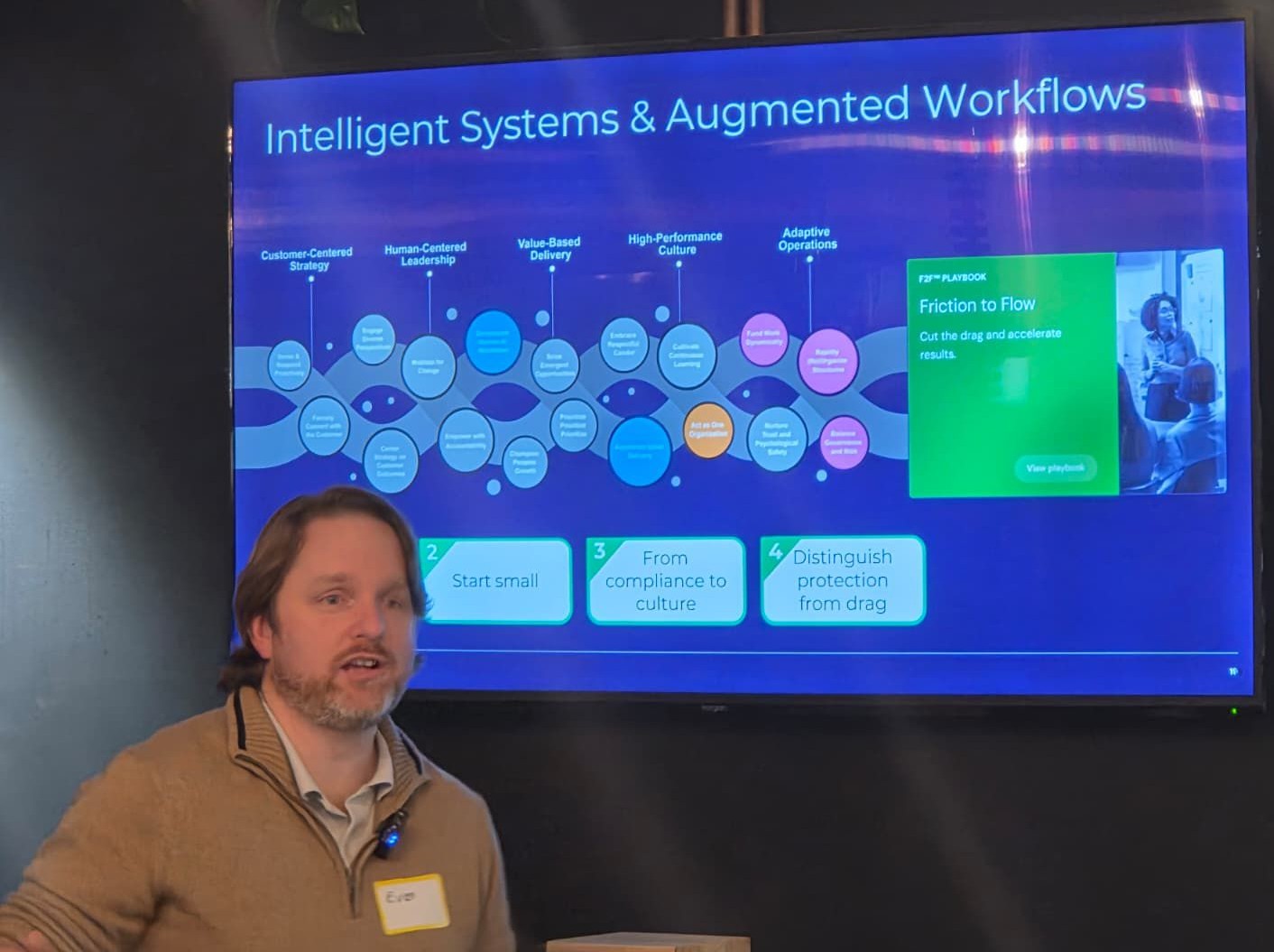
- Orchestrate human-AI workflows: the most significantly evolved capability, from “unleash workflow creatively”. “Creatively” never landed, and AI has become unavoidable since 2020. The point is designing end-to-end workflows where AI, other intelligent systems, or human intelligence is a genuine member of the flow and the people closest to the work shape it.
A telling finding from BAI’s AI research: of the top constraints limiting return on AI investment, only one was technical (data quality). The rest were about the business environment and particularly governance processes that can’t keep up. As Evan put it: if AI helps you create value three times faster, can your leaders make decisions three times faster?
4. High-Performance Culture
(previously: Engaging/Engaged Culture, executives now talk about wanting a “high-performance culture”, so the model uses their language)
- Nurture trust and psychological safety: was “embed psychological safety”. “Trust” was added deliberately: psych safety is one expression of trust, but it has become something of a buzzword on its own.
- Cultivate continuous learning: was “cultivate a learning organisation”, a phrase that had lost meaning. Learning here is not education; it’s running experiments and extracting insight from what worked and what didn’t.
- Embrace respectful candor: was “engage transparently and courageously”. The word “respectful” is doing real work: it guards against people weaponising “transparency” or “candour” as cover for bad behaviour.
- Act as one organisation: was “act as one”; “organisation” was added purely for clarity (it doesn’t mean everyone is on one 200-person team, it means everyone is pointed in the same direction).
5. Adaptive Operations
(previously: Flexible Operations, “adaptive” is more meaningful than “flexible”)
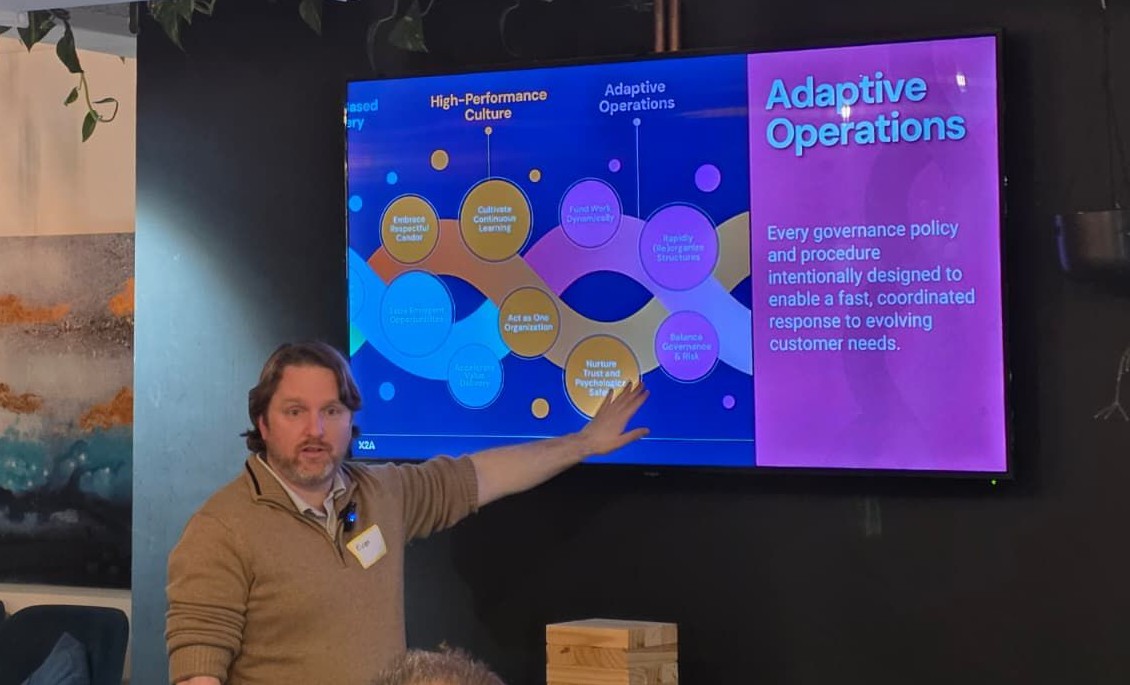
- Balance governance and risk: unchanged, and Evan’s long-held favourite. Most organisations will spend $5 in governance process to avoid $1 of risk. In BAI’s profiles, this and fund work dynamically are the weakest capability in roughly 95% of organisations studied.
- Fund work dynamically: unchanged. Can you move money from where it is allocated to where it’s needed, without impediment or delay? Most can’t.
- Rapidly (re)organize structures: was “reorganise structures fluidly”. “Rapidly” makes it clear this isn’t an annual restructure, it’s the ongoing ability to move the right people to where they need to be, when they need to be there, without friction.
A live thread in the room: ethics is moving from a background to a foreground concern. The team debated whether to make it explicit and, for now, it lives at the behaviour level in a few places.
The behaviour-change conversation
Takeaway 3 got the longest discussion in the room: how change actually happens, prompted by a participant whose organisation kept defaulting back to waterfall despite agreeing to try something new.
Evan gave two points of view. The straight answer: it has to come from the top. If senior leaders don’t model the new behaviours, the change won’t stick. He has seen agility evaporate within six months when a new leader arrives with a different mental model of how work should run.
The correct answer draws on behavioural economics: people are predictably unpredictable, so the durable move is to design an environment where the desired behaviour becomes the path of least resistance.
The seat belt was used as an example: law gets you to ~70% compliance, fines push that to 80–90%, but the nudge, the annoying beep that makes it easier to buckle up than not, is what closes the gap to ~100%. (Though kids in the back seat nagging you are the biggest nudge of all.)
The lesson for change agents: build the environment so the behaviour is natural, and it will survive leadership turnover and incentive drift. He tied this back to incentives with the Deming-flavoured warning that a measurable target handed to a manager becomes the behaviour you get.
From model to action: the four X2A playbooks
Takeaway 4 in practice: the merger’s payoff is a set of playbooks, and Evan was emphatic that these are not consulting playbooks. The metaphor is from sport: a play is a drill you repeat to build muscle memory, with multiple options that adapt to what’s in front of you.
Four playbooks launched, each targeting a common challenge:
- Vision to Value: the product operating model; building products that resonate with one specific target segment (who then become your advocates), rather than products everyone mildly likes.
- Friction to Flow: governance. Keep the good friction (the surgeon checking which leg) and remove the friction that adds cost without reducing meaningful risk.
- Hierarchy to Ownership: empowerment. The most common middle-manager complaint is “I’m trying to delegate, but no one takes ownership.” Have we ever taught anyone how to take ownership, how to empower with accountability? Usually not.
- Now to Next: change leadership; the sustainable behaviour-change approach above, built on triggers and nudges.
The full model of five domains, 18 capabilities, and 85 behaviours is freely available and Creative Commons licensed at the Business Agility Institute. The X2A side of the story lives at x2a.com/science.
Recording
The raw, unedited recording is available on YouTube.
Thanks
- Evan Leybourn for your insights, time, and captivating tangents.
- The Melbourne Business Agility Meetup team, working tirelessly behind the scenes to bring you these events.
- TeamForm for ongoing sponsorship of refreshments and location. Tying into this evening’s topic, rapidly reorganising organisational structures taking into account their complexities across strategy, workforce, capabilities, budgets and aspirations is difficult; TeamForm’s tooling accelerates assessment, change, and follow-through.